
"How much should we spend on SEO?" is one of the first questions every business owner asks me. The honest answer is that it depends on how competitive your market is and how many areas of your SEO need work. But I can give you real numbers, and explain what sits behind them.
Typical Monthly SEO Budgets For SMEs
For a small or medium-sized business, a monthly SEO campaign usually falls into one of three ranges:
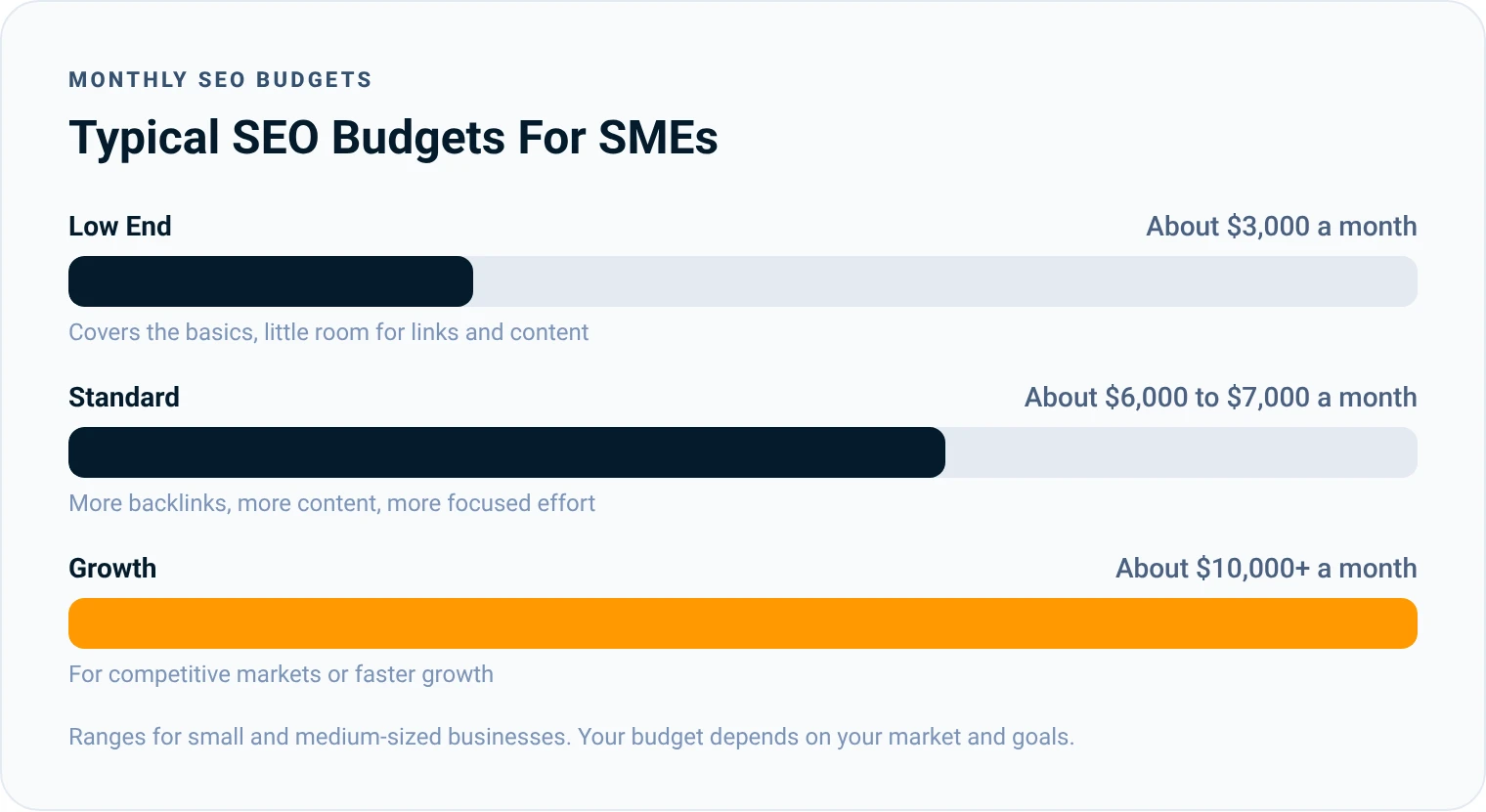
- About $3,000 a month: This is the low end. It can work, but it leaves little room for link building and content.
- About $6,000 to $7,000 a month: A standard campaign, with more backlinks, more focused effort and more content.
- About $10,000 a month and above: For more competitive markets, or businesses that want to grow faster.
So a rough range is $3,000 to $10,000 a month. At SMESEO, monthly SEO starts at $3,000 and is scoped after a short call, and our SEO audit is a fixed $1,500.
What Each Budget Level Pays For
The difference between the levels is not the quality of the work. It is how much of the work can be done each month.
At the low end, the budget covers the essentials: keeping the website technically healthy, improving the most important pages, and a small amount of link building. Progress is possible, but slower, and some areas will have to wait.
A standard campaign has room for a proper link building campaign, a regular flow of new content, and more time spent improving the pages that bring in leads. This is where most SMEs see the best balance of cost and progress.
At around $10,000 a month and above, every area can be pushed at the same time. This suits businesses in competitive markets, or those that want to grow quickly in new services or regions.
SEO is won by brands that are credible and trustworthy, that show that strength outward and provide a valuable experience on the website. Every big area has to be looked at. Nowadays, with AI, we cannot be weak in any area, and every area that matters has to be supported with resources, budget, commitment and effort.
 Christopher LierSEO Consultant And Founder Of LinkPanda
Why SEO Needs Every Area Covered
To bring in traffic that turns into leads, you have to be competitive in every main area of SEO. Search is won by brands that are credible and trustworthy, that show that strength to the outside world, and that give visitors a good experience on their website.
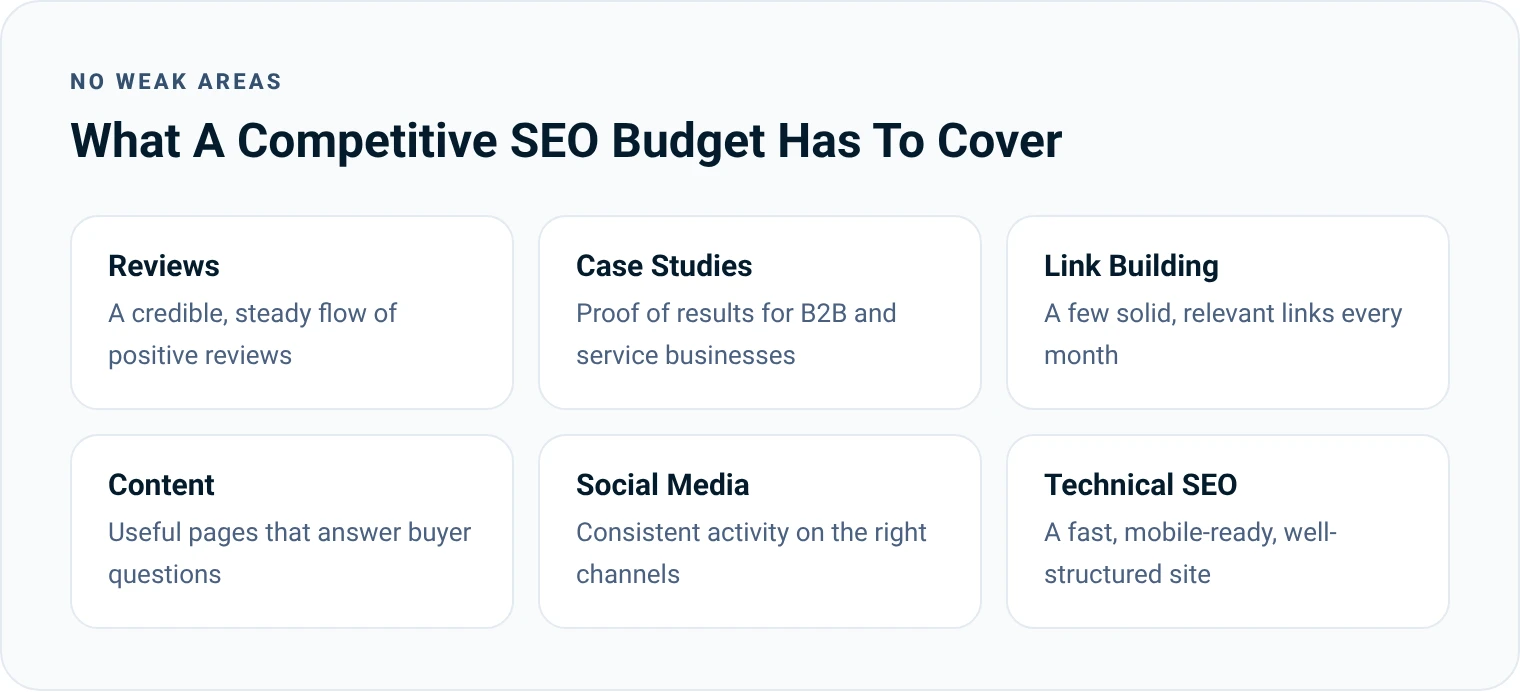
With AI search, you cannot afford a weak spot. A strong SEO presence today needs:
- A credible review presence
- Enough case studies, if you are a B2B or service business
- A consistent link building campaign that earns good links every month
- A regular content program
- Some activity on social media
- A website that is technically sound
If one important area is neglected, it holds back everything else. Each of these areas needs budget, people and time.
What Happens When SEO Is Done Too Cheaply
The biggest mistake I see is aiming too low. SEO is not a channel that delivers on a short-term, low-budget mindset. When a business tries to save money by cutting corners, the campaign never reaches the level of support it needs to have a fair chance, and the money that was spent is largely wasted.
Part of my job as an SEO consultant is to set realistic expectations, and that means saying it plainly: SEO cannot be won on a minimal level.
Why One Person Is Rarely Enough
SEO covers research, technical work, content, link building and reporting. One person can only do so much. Link building alone is a task that needs constant attention and never stops.

That is why, for most small businesses, an agency is the most cost-effective way to start. You get every area of SEO covered without hiring and managing a full team yourself. As a business grows, the ideal setup is an agency working together with an in-house marketing team. I explain the options in how to choose an SEO company.
Look At SEO As An Investment
Your SEO budget should not only be judged by the tasks and deliverables it pays for. It should be judged by the return it produces.
If you invest a certain amount and we bring you back that amount plus a good margin on top, we have done our job.
SEO also builds an asset. Paid ads stop the day you stop paying. Rankings, content and links keep working, and they give you a steady flow of traffic and leads even when demand in your market goes up and down.
How The Return Is Measured
The return looks different for every business:
- Online shops, SaaS and subscription businesses: Sales and sign-ups that come directly from organic search.
- B2B and service businesses: Qualified leads coming in through the contact form and other enquiry pages.
- Businesses entering new markets: Traffic growth in a new segment or region.
- Brands focused on authority: Domain rating gains and quality backlinks secured each month.
Most commonly, we measure SEO against results tied directly to revenue and leads. We agree these goals at the start and report on them every month, so you can see what your budget is producing.
SEO Or Google Ads: Where Should The Budget Go?
If your business is just starting out, ads are a quick way to get market feedback and leads while you learn what your buyers respond to. SEO makes more sense once you clearly know your market, audience and services, and are committed to growing your website over the long term.
For larger SMEs, running both is standard. Leads are the lifeblood of any business, and both channels should be tracked and profitable.
How Long Before You See A Return?
Plan for 6 to 12 months before SEO delivers meaningful leads. I explain why in how long SEO takes.
What A Good SEO Proposal Should Include
Whatever budget you choose, the proposal should make it clear what you are paying for. Before you sign, check that it covers:
- Clear goals, such as qualified leads, sales or traffic in a new market, agreed before work starts
- The work included each month, across technical SEO, content, link building and the other areas your business needs
- How results will be measured, and how the numbers tie back to revenue and leads
- How you will be kept updated. With us, that means a monthly report, one to two strategy calls a month as needed, and a Slack channel for day-to-day questions
- The commitment. We ask for a minimum of 3 months, occasionally 6, while being clear that SEO needs a medium to long-term mindset
If a proposal only lists a price and a vague list of tasks, ask for more detail. A good SEO partner will happily explain where every dollar goes.
Questions To Answer Before You Set A Budget
Before you decide on a number, it helps to be clear on a few things:
- Which services or products do you most want to sell more of?
- Who is your ideal customer, and where are they?
- What is a new customer or lead worth to your business?
- How competitive are the searches you want to win?
- Do you have anyone in-house who can help with content or approvals?
The answers shape the right budget far more than any price list.
Where To Start
If you are not sure what your business needs, start with an audit. It shows where your website stands, what your competitors are doing and where the budget will have the biggest effect. You can see our prices on the SEO pricing page, or get in touch for a quote based on your goals.
Christopher Lier
Christopher has worked in SEO since 2015 and is the founder of LinkPanda, the agency behind SMESEO. He helps small and medium-sized businesses get more customers from Google and AI search.
More about Christopher